
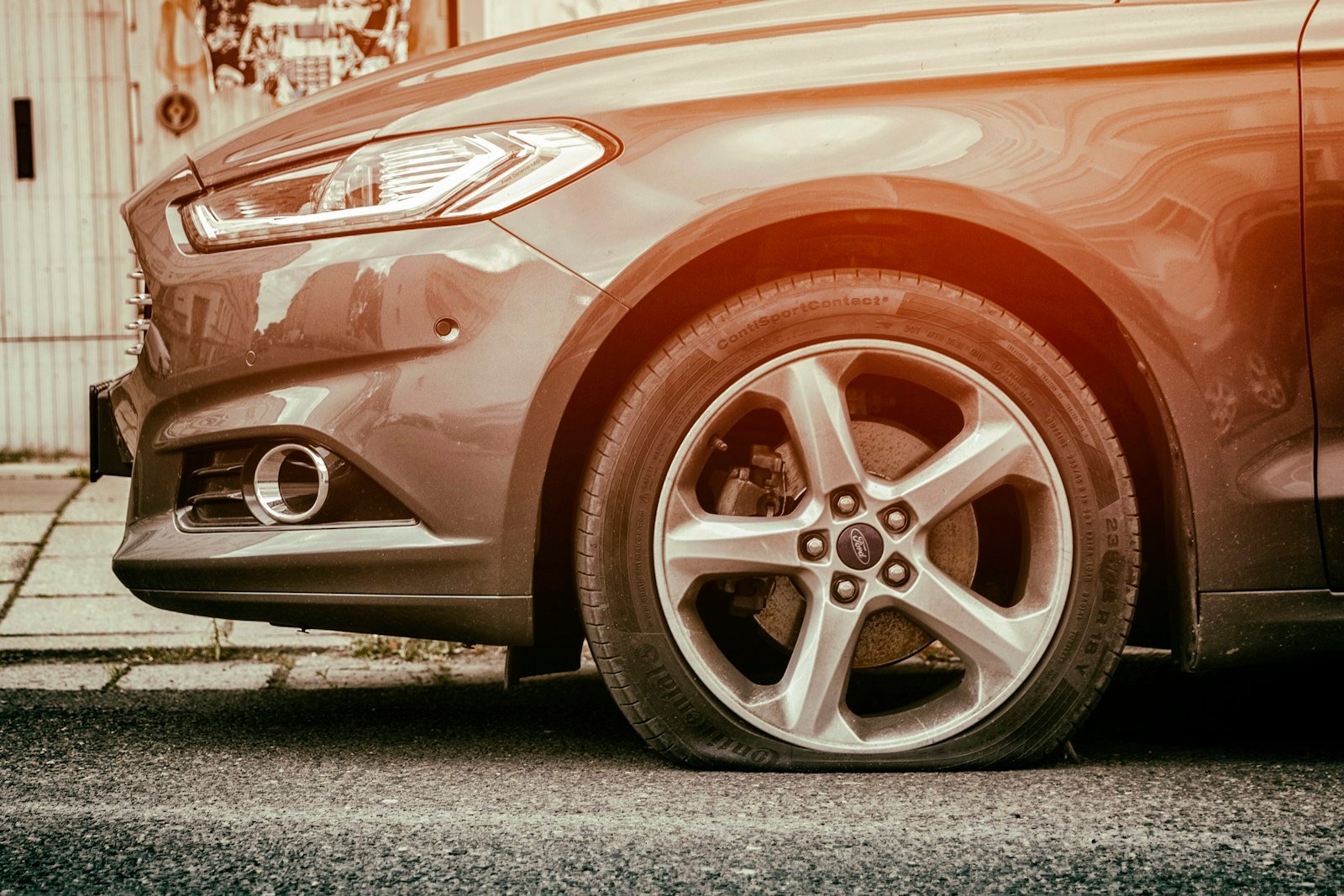
What should my tyre pressure be? How to find and set the right figure

“What should my tyre pressure be?” has one honest answer: the figure your car’s manufacturer printed for your tyre size and your load. It is not a number a forum, a friend or the air machine can give you, and it is often different front and rear. The good news is that it takes a minute to find, a few minutes to set, and the rest is reading it at the right moment.
In short
| Question | Answer |
|---|---|
| Where is my figure? | Sticker on the driver’s door pillar or inside the fuel flap, and in the handbook |
| PSI or bar? | Both describe the same pressure: 1 bar is about 14.5 PSI |
| Which line on the sticker? | The one for your tyre size, and the “full load” line when the car is loaded |
| When to check? | Tyres cold, before a journey. The Highway Code says weekly |
| What about the figure on the tyre? | That is the tyre’s maximum, never the pressure to run |
| Is it an MOT item? | Pressure itself is not measured, but a faulty TPMS fails cars first used from 1 January 2012 |
Where your car’s tyre pressure is written
Open the driver’s door and look at the edge of the door frame, the B-pillar, the upright between the front and rear doors. Most cars carry a printed label there. On others it sits inside the fuel filler flap, and on some older cars on the edge of the door itself or under the bonnet.
The handbook has the same table, usually in the “technical data” or “wheels and tyres” chapter. If the sticker is missing or unreadable on a used car, the handbook is the reference, and a main dealer can give you the figure from the registration.
Take the time to find it once and write it down. At the workshop counter, the drivers who had their figure on a note in the glovebox were the ones whose tyres wore evenly.
How to read the tyre pressure sticker
A typical label is a small grid. Each line starts with a tyre size (for example 205/55 R16), followed by two or four pressures: front and rear, for normal load and for full load. The units are often given twice, in bar (or kPa) and PSI.
Start by reading the size printed on the sidewall of your own tyres, the side face of the tyre, then find the matching line. A car sold with several wheel sizes can have different pressures for each, and using the line for 16-inch wheels on 18-inch ones is a common mistake.
Normal load or full load
The normal figures cover the driver and a passenger or two with light luggage. The full load or “laden” figures, usually higher at the rear, are for a car with every seat taken, a packed boot, a roof box or a caravan on the back.
The Highway Code puts it plainly: as of November 2026, Annex 6 says tyres “MUST be correctly inflated to the vehicle manufacturer’s specification for the load being carried”. Before a holiday with a full boot, the laden line is the one that applies. Come back to the normal figures once the car is light again, otherwise the ride gets harsh and the centre of the tread wears faster.
Some cars show an “eco” figure
A few labels add an economy pressure, slightly higher, meant to reduce rolling resistance. It is a manufacturer-approved option, not an obligation, and it can make the ride firmer. If in doubt, use the standard line.
PSI, bar and kPa: one pressure, three units
Forecourt air machines in the UK usually show PSI (pounds per square inch), and many can switch to bar. European labels often lead with bar or kPa (kilopascals). The conversions are fixed: 1 bar is 100 kPa, and 1 bar is about 14.5 PSI.
Worked example: the sticker reads 2.3 bar at the front and 2.1 bar at the rear. Multiply by 14.5: 2.3 x 14.5 = 33.35, so 33 PSI at the front, and 2.1 x 14.5 = 30.45, so 30 PSI at the rear. If the label says 230 kPa, divide by 100 to get 2.3 bar and carry on the same way.
The number on the tyre is not your pressure
The sidewall also carries a marking such as “Max inflation pressure” followed by a figure in kPa and PSI. That is the highest pressure the tyre structure is rated for, whatever car it is fitted to. It says nothing about the pressure your car needs.
Inflating to that maximum shrinks the contact patch, the area of rubber actually touching the road. Grip and braking suffer, especially in the wet, and the car feels nervous over bumps.
Check the pressure when the tyres are cold
Air expands as it warms, so a tyre that has just done a motorway run reads higher than the same tyre after a night in the drive. The figure on the sticker is a cold pressure. The Highway Code, as of November 2026, asks you to check weekly, “before your journey, when tyres are cold”, and warns that “warm or hot tyres may give a misleading reading”.
In practice, cold means the car has stood for a few hours, or has only covered a short, gentle drive to the nearest air machine. If you have to check warm tyres on a long journey, never let air out to bring them down to the sticker figure: once they cool, they will be under-inflated. Top up only the ones reading below the figure, and recheck properly at the next cold stop.
How to check and adjust the pressure
- Find your figure and decide whether the normal or full-load line applies.
- Unscrew the valve cap and keep it somewhere safe.
- Press the gauge or the air line firmly and squarely onto the valve until the hissing stops, then read the pressure.
- Add air in short bursts and read again, or press the valve core gently to let air out if a tyre is over the figure.
- Do all four wheels, then refit the caps: they keep dirt and moisture out of the valve.
A cheap digital gauge kept in the car is worth having. Forecourt gauges take a lot of abuse, and comparing their reading with your own tells you whether you can trust them. If your car has a space-saver or full-size spare, check it too: its own pressure is on the sticker or in the handbook, and it is often higher than the road wheels.
This is a job anyone can do. The only reason to hand it to a garage is a tyre that keeps losing air, which needs to be taken off the rim and inspected for a puncture or a leaking valve.
What wrong pressures do to the car
An under-inflated tyre flexes more, heats up and wears on both outer edges. Steering feels heavy, fuel consumption rises, and at sustained motorway speed the extra heat can damage the tyre’s structure from the inside. The Highway Code notes that brakes and steering are “adversely affected by under-inflated or over-inflated tyres”.
An over-inflated tyre wears in the centre, grips less and makes the car skip over ripples in the road. Neither error is visible from the driver’s seat until it is bad: a tyre can be well below its figure and still look normal, which is why a gauge beats a glance.
A pressure that drops by the same amount on one tyre week after week points to a slow puncture, a damaged valve or a corroded rim edge. Topping it up every Saturday is not a repair.
Tyre pressure warning light and the MOT
Most recent cars have a TPMS (tyre pressure monitoring system). Some use a sensor inside each wheel that reads the actual pressure; others compare wheel speeds through the ABS sensors and spot a tyre that has gone softer, and therefore turns faster. With the second type, the system must be reset from the dashboard menu or a button after you adjust the pressures, as the handbook describes.
At the MOT, the testers do not measure your tyre pressures. As of November 2026, the GOV.UK MOT inspection manual lists an obviously under-inflated tyre as a minor defect, and a TPMS that is malfunctioning or obviously not working as a major defect, which is a fail, on passenger cars first used on or after 1 January 2012. A light that flashes for a while then stays on usually signals a system fault rather than low pressure.
If the light comes on while driving, slow down, stop somewhere safe and look at all four tyres before deciding whether to carry on to an air line. The other warning lights on your dashboard follow the same logic of colour and urgency, as explained in our article on the engine warning light. More tyre and braking topics are in our Safety section.
Do electric and hybrid cars need different pressures?
Not as a rule of physics, but heavier cars often carry higher figures on their sticker, and an electric version of a model can have different pressures from the petrol one. The method does not change: read the label on that car, for that tyre size, cold. Under-inflation on an electric car also shows up quickly as lost range.
