
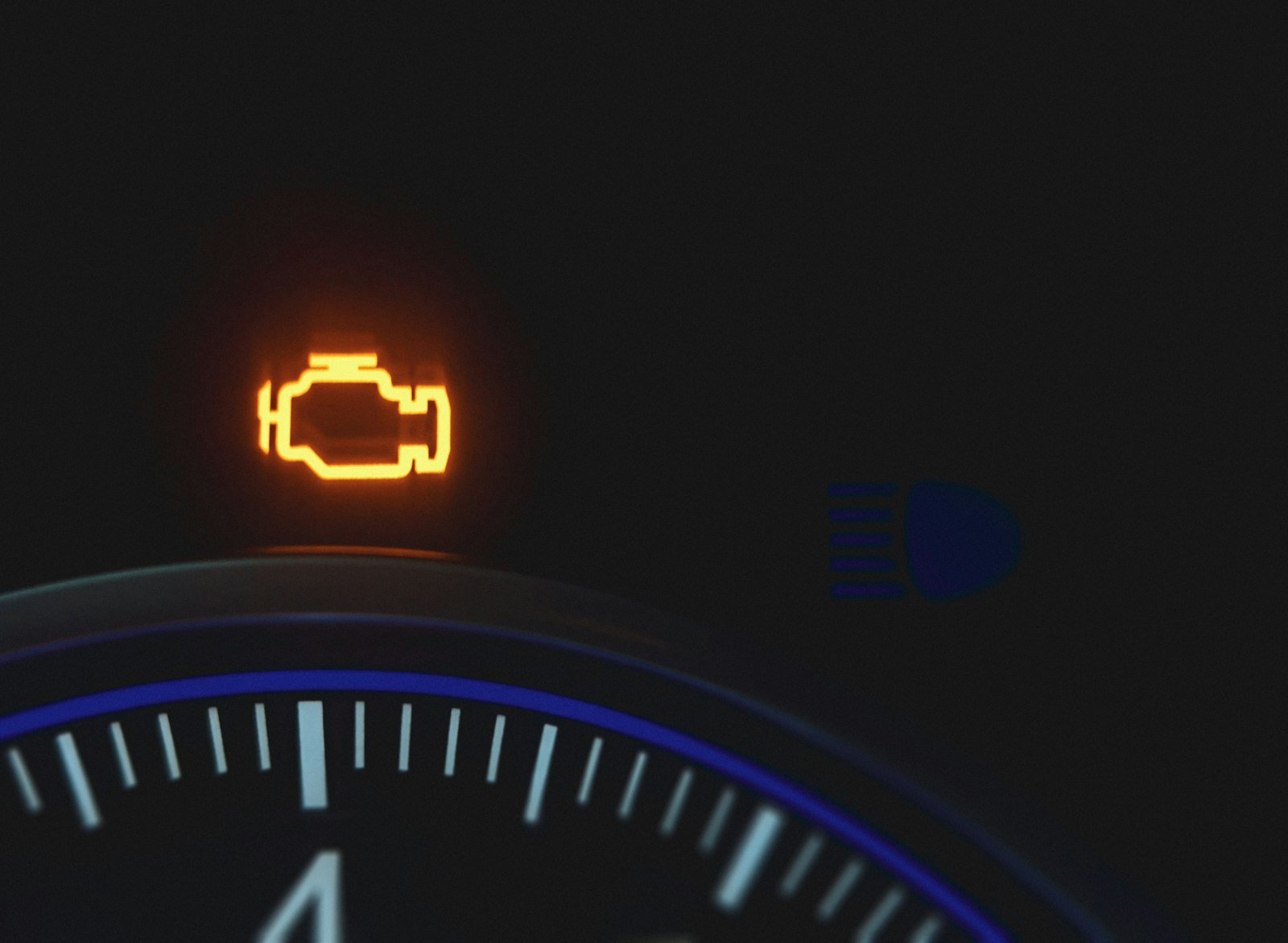
Engine warning light: steady or flashing, what to do

The little amber engine symbol has just come on and the car feels exactly the same as it did a minute ago. The engine warning light does not mean “breakdown”; it means “I have logged a fault”. What matters is whether it stays steady or flashes, and what the car is doing at the same time. Those two clues are enough to decide whether you can finish your journey or need to back off right now.
In short
| What you see | What it means | What to do |
|---|---|---|
| Comes on for a few seconds with the ignition, then goes out | Normal bulb check | Nothing |
| Steady, car drives normally | Fault logged, often a sensor or the emissions system | Drive gently and have the code read in the next few days |
| Steady with a loss of power | Limp mode: the engine is protecting itself | Short, careful trip to a garage |
| Flashing | Misfires that put the catalytic converter at risk | Ease off, stop as soon as it is safe, do not carry on |
| Red engine symbol (on some cars) | Serious fault | Pull over, switch off, call for assistance |
What this light actually watches
The engine warning light, also called the engine management light (EML), the check engine light or, in the MOT manual, the malfunction indicator lamp (MIL), is switched on by the engine control unit (ECU), the computer that runs fuelling and ignition. It lights up when a sensor reports a value outside its expected range, especially when that fault could raise emissions.
So it covers far more than the engine itself: oxygen sensors, the catalytic converter, the diesel particulate filter, the EGR valve (which feeds some exhaust gas back into the intake), injection, ignition and sometimes an automatic gearbox. That is why it so often comes on for faults that are not mechanically serious.
When you switch the ignition on, it lights for a few seconds and then goes out. That proves the bulb works. If it never lights at all with the ignition on, that is a fault too, and the MOT treats it as one.
Steady light
A steady light means the ECU has found a fault and stored it in its memory with a code. The danger is not immediate, but in most cases the fault will not go away on its own.
Steady, and the car drives normally
You can finish your journey driving smoothly, without revving the engine hard. At the workshop counter, a good share of these lights came from a tired sensor or a fuel cap that had not been clicked shut after filling up.
Do not leave it for weeks, though. An oxygen sensor that reads wrongly makes the engine use more fuel and can end up damaging the catalytic converter, a far more expensive part than the sensor.
Steady with a loss of power
If the car will not rev or tops out at a low speed, it has gone into limp mode. The ECU deliberately restricts the engine to protect it, often because of a turbo, EGR valve or boost pressure problem.
Limp mode is there to get you to a garage, not to take you on holiday. Keep off the motorway if the car can no longer accelerate properly: joining fast traffic without power is dangerous.
Flashing engine warning light
A flashing light is the most serious message this lamp can give. It usually means misfires: one cylinder is not burning its fuel properly, and unburnt petrol is going into the exhaust.
That fuel finishes burning inside the catalytic converter, which then reaches temperatures it was never designed for. A few dozen miles like this can be enough to destroy it.
Ease off straight away and stop as soon as you can do so safely. If the engine shakes at idle, do not set off again: have the car recovered rather than adding a catalytic converter to the bill.
The most common causes
The light never says which part is at fault. These are the ones found most often behind this light, with the clues that point to each.
| Likely cause | Clues | Who deals with it |
|---|---|---|
| Fuel cap not closed or seal damaged | Light came on just after filling up | You: tighten until it clicks, then allow several journeys |
| Spark plug or ignition coil (petrol) | Engine shaking, light flashing | Confident DIYer or garage |
| Oxygen (lambda) sensor | Higher fuel use, smell of petrol at the exhaust | Garage |
| Dirty mass airflow sensor | Flat spots when accelerating, uneven idle | Garage, cleaning sometimes possible |
| Clogged EGR valve (mostly diesel) | Black smoke, jerking, limp mode | Garage |
| Blocked diesel particulate filter | Lots of short trips, loss of power | Garage, after a regeneration drive if the handbook allows it |
| Injector | Hard starting, smoke, knocking | Garage |
On a petrol engine that shakes while the light flashes, the plugs and coils are the first suspects. They are also the parts a garage will check first, because they are quick to test.
Reading the fault code yourself
Every recent car has an OBD diagnostic socket, a 16-pin connector inside the cabin, usually under the steering column or behind a small cover near the pedals. An OBD reader plugged into it shows the code stored by the ECU.
The codes follow a common standard: a letter followed by four digits. Codes P0300 to P0308 point to misfires, the last digit giving the cylinder; P0420 means the catalytic converter’s efficiency is judged too low.
A code points the diagnosis in a direction; it does not replace checking the part. An oxygen sensor code can come from an air leak in the exhaust, and a misfire code from an injector rather than a plug. Write the code down before anyone touches the car and give it to the garage.
Clearing the light does not fix anything
Disconnecting the battery or clearing the code with a reader turns the light off, not the fault. If the fault is still there, the ECU finds it again after a few journeys and the light comes back.
Disconnecting the battery has a hidden cost as well: the car loses its learnt values, and some radios and electric windows then need resetting.
The engine warning light and the MOT
Do not count on clearing the code to get through the MOT either. According to the DVSA MOT inspection manual for cars (section 8, checked on GOV.UK in November 2026), the tester switches the ignition on, checks that the lamp lights and then goes out, and records an engine MIL that is inoperative or indicating a malfunction as a major defect, which means a fail.
That check applies to petrol cars first used on or after 1 July 2003 and to diesel cars first used on or after 1 July 2008, hybrids included. If the fault is real, the light is likely to come back before your test date anyway, so fix the cause rather than the symptom.
What you can do yourself, and what belongs to the garage
Within your reach: check the fuel cap is properly tightened, check the oil level and the coolant level with the engine cold, and note when the light came on (cold engine, uphill, just after filling up). If another warning light comes on at the same time, the temperature light in particular, stop and let the engine cool before going any further.
For a confident DIYer with the right tools: read and note the code with an OBD reader, replace spark plugs on a petrol engine with easy access.
For the garage: anything involving injection, the turbo, the EGR valve, the particulate filter or the catalytic converter. These parts need a diagnostic tool that can read live data, and sometimes coding of the ECU after replacement. More checks of this kind are in our Maintenance section.
