
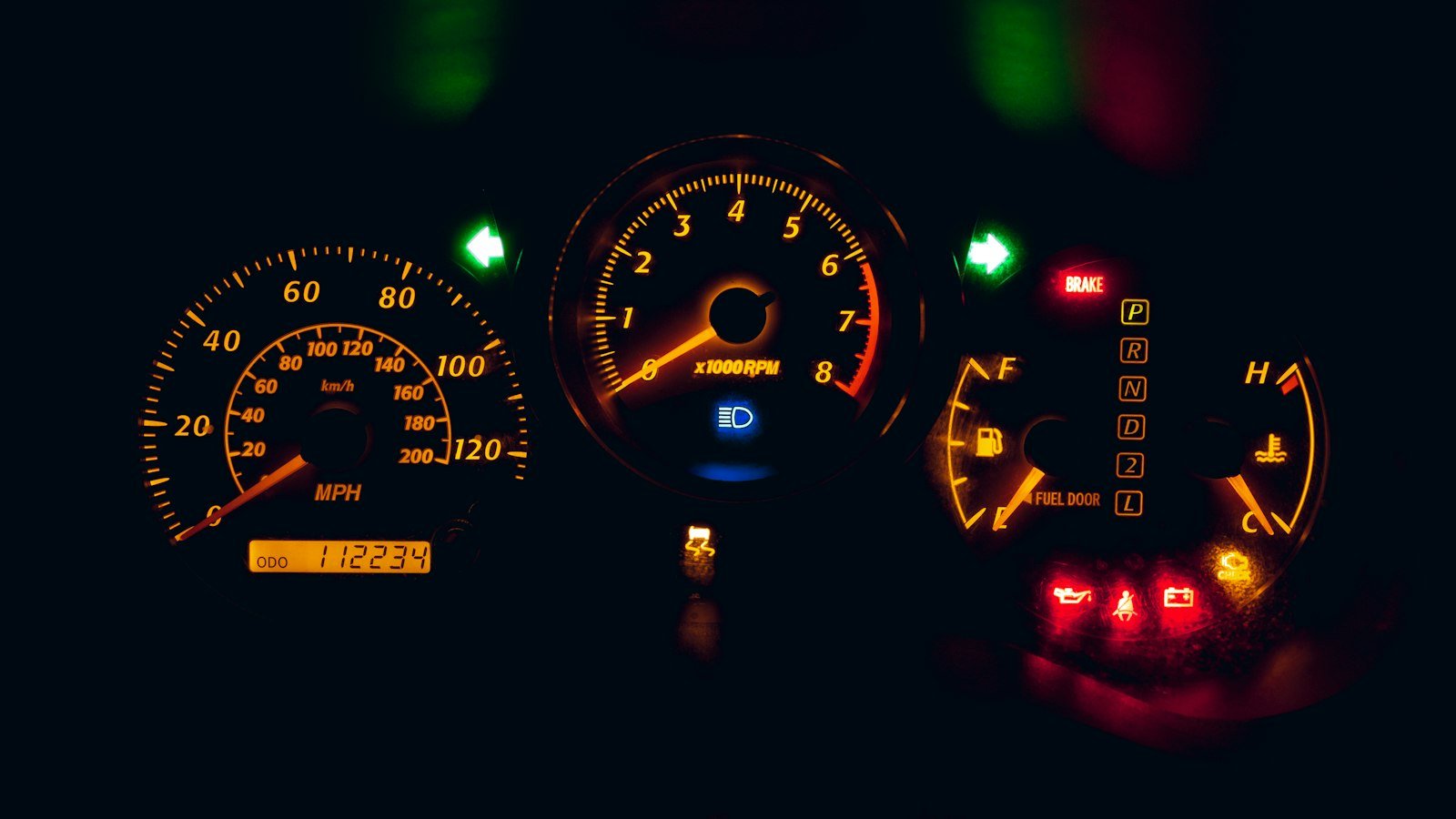
Dashboard warning lights: what each colour means and what to do

A symbol you have never seen before has just lit up next to the speedometer. Before reaching for the handbook, look at its colour: dashboard warning lights follow a code shared by almost every manufacturer, and that colour already tells you whether to stop on the hard shoulder, finish your journey gently or simply carry on. The shape of the symbol then tells you which system is talking, and whether it is steady or flashing tells you how urgent it is.
In short
| Colour | What it means | What to do |
|---|---|---|
| Red | A fault that can damage the engine or affect your safety | Stop as soon as it is safe, switch off, do not drive on until you know the cause |
| Amber or yellow | A system has a fault or needs attention soon | Carry on gently, check what you can, have it looked at within days |
| Green, blue or white | A function is switched on (lights, indicators, cruise control) | Nothing, it is information |
| Flashing amber or red | The fault is happening right now, often more serious than steady | Ease off and treat it one level higher |
| Lights at start-up that go out | Normal bulb check | Nothing |
| A light that never comes on at start-up | The warning itself is faulty, and the MOT checks this | Have it repaired |
How to read the colour code
Think of a traffic light. Red means the car is telling you that continuing could cost an engine or reduce your ability to steer or brake. Amber (some handbooks say yellow or orange, it is the same thing) means a system has logged a fault or a level is getting low: no immediate danger, but the problem will not fix itself. Green, blue and white symbols only confirm that something is switched on, such as dipped headlights, main beam (always blue) or an indicator.
Two details change the reading. A flashing light usually means the fault is active at that very moment: a flashing engine light, for instance, signals misfires that can overheat the catalytic converter. And the same symbol can exist in two colours on one car: amber for “check soon”, red for “stop now”. The handbook of your car is the only document that gives the exact meaning for your model, so it is worth knowing where it is (glovebox, or the manufacturer’s online handbook found with your registration or VIN).
The light show at start-up is a test
When you switch on the ignition, most warning lights come on together for a few seconds and then go out one by one. That is the car testing each bulb or LED and each control unit. It is normal, and it is the moment to glance at the cluster.
The light worth worrying about is the one that stays on once the engine is running, or the one that never comes on at all during that test. A warning that cannot light up cannot warn you either, and at the workshop counter we regularly found an airbag or engine light that had been disconnected or had its bulb removed by a previous owner. If you are viewing a used car, watch the cluster as the ignition goes on.
Red warning lights: stop as soon as it is safe
A red light does not mean “brake hard where you are”. Indicate, slow down, and stop in a safe place: a lay-by, a car park, or on a motorway the next exit or services if the car still behaves normally. Then switch off and work out what the light is telling you.
Oil pressure (red oil can)
This is the most urgent one. The oil pressure light means the engine is no longer getting enough oil pressure to keep a film of oil between its moving parts. A few minutes of driving like this can ruin the crankshaft bearings. Switch off straight away, wait a few minutes and check the level on the dipstick, the metal rod with a marked end that shows the oil level in the sump.
If the level was low and the light goes out after topping up with the oil specified in the handbook, you can drive gently to a garage to find the leak or consumption. If the level is correct and the light stays on, do not restart: the cause may be the oil pump or a blocked strainer, and the car needs recovering.
Engine temperature (red thermometer)
The coolant is too hot. Stop, switch off and never open the expansion tank while the engine is hot: the system is under pressure and the coolant can spray out above boiling point. Wait at least 30 minutes, until the top hose feels only warm, then check the level against the MIN and MAX marks on the tank.
Some cars show the same thermometer in blue when the engine is still cold. That one only means “go easy until it warms up”.
Battery or charging (red battery)
Despite its shape, this light rarely means the battery itself is dead. It means the alternator, the engine-driven generator that recharges the battery, has stopped charging. The car now runs on the battery’s reserve alone, and that reserve runs out faster the more you have switched on.
On many engines the same auxiliary belt drives the alternator and the water pump. If the belt has snapped, the temperature can climb quickly as well. Watch the temperature gauge: if it rises, stop.
If it stays normal, switch off everything you do not need (heated screen, fan, seat heaters) and head straight for a garage. Our article on how long a car battery lasts explains how to test the battery once the charging fault is fixed.
Brake system (red exclamation mark in a circle)
First check the obvious: on many cars this light also comes on when the handbrake is applied, or not fully released. If it stays on with the handbrake off, it usually means the brake fluid level is low, which points either to very worn pads or to a leak.
Stop and look at the fluid reservoir under the bonnet. Do not drive on if the pedal feels soft, travels further than usual or the light came on together with the ABS light: that combination can mean the system that balances braking between front and rear axles is not working either. Brakes are not a job for guesswork, so call for recovery rather than nursing the car home.
Airbag (red figure with a circle)
The airbag light (sometimes labelled SRS, for supplementary restraint system) means a fault has been found in the airbags or the seat belt pretensioners, the small charges that tighten the belts in a crash. The car drives normally, but the system may not work in a collision. Drive carefully to a garage soon and never try to unplug or probe the airbag wiring yourself: an airbag can fire if handled wrongly.
Power steering (red steering wheel)
The steering will suddenly feel much heavier, especially at low speed. On cars with electric power steering, stopping, switching off and restarting after a minute sometimes clears a temporary fault. If the light stays red, the car can still be steered, but it takes real effort: drive slowly to the nearest garage or call for help.
Amber warning lights: carry on, but book it in
An amber light does not oblige you to stop, but it should change how you drive until the fault is found: gently, without hard acceleration, and with the radio low so you can hear any new noise.
Engine warning light
The engine outline is the amber light drivers see most often. Steady, it means a fault has been stored, often a sensor or the emissions system. Flashing, it means misfires: ease off and stop as soon as it is safe. Our full guide to the engine warning light explains how to read the fault code and why clearing it does not get you through the MOT.
ABS (amber “ABS” in a circle)
The ABS (anti-lock braking system) stops the wheels locking under heavy braking so you can still steer. With this light on, your normal brakes still work, but the wheels can lock in an emergency stop on a wet or icy road. Leave a bigger gap and have it checked: the cause is often a wheel speed sensor covered in dirt or a damaged wire near the wheel.
Stability control (car with wavy lines)
ESC or ESP (electronic stability control) brakes individual wheels to keep the car on its line when it starts to slide. If this light flickers on a slippery road, the system is working, and it is telling you grip is low. If it stays steady, the system has a fault or has been switched off: look for a button with the same symbol and the word OFF.
Tyre pressure (horseshoe with an exclamation mark)
The TPMS (tyre pressure monitoring system) has detected a tyre that has lost pressure. Slow down, stop somewhere safe and look at all four tyres. If none is visibly flat, drive gently to an air line and set the pressures written on the sticker in the door pillar or fuel flap, then reset the system as the handbook explains. Our article on what your tyre pressure should be shows how to read that sticker.
Brake pad wear (circle with dashed brackets)
A sensor in the pad has touched the brake disc, which means the friction material has worn down to its limit. You still have braking, but the pads need replacing soon, before the metal backing plate starts eating the disc. Book it within days, not weeks.
Diesel particulate filter (box with dots)
On a diesel, the DPF (diesel particulate filter) traps soot from the exhaust and burns it off from time to time, which needs a hot exhaust. Short trips stop that from happening and the filter clogs. The handbook usually describes a drive that lets it clean itself, typically a steady run at motorway or dual carriageway speed for a set time. If the light stays on after that, or the car loses power, a garage needs to look at it before the filter is damaged.
Glow plugs (amber coil, diesel only)
On a diesel, this coil lights up when you switch on the ignition while the glow plugs, small heaters that warm the combustion chambers, get the engine ready to start. Wait until it goes out, then start. If it flashes or comes back on while driving, many manufacturers use it as an engine fault warning: treat it like the engine light.
Low fuel, washer fluid, coolant level
Some amber lights are simple reminders: low fuel, washer fluid, or on some cars a coolant level that has dropped to the MIN mark. They need a top-up, not a garage. A coolant level that keeps dropping, though, is a leak, and it deserves a look before it turns into the red temperature light.
Green, blue and white: information only
These confirm that a function is on: dipped headlights (green), main beam (blue), front and rear fog lights (green and amber respectively on most cars), indicators, cruise control, eco mode, or the “READY” symbol on a hybrid showing it can move off silently. They need no action, except one habit: switch off the rear fog light when visibility improves, as it dazzles drivers behind you.
The triangle and the message screen
Many recent cars have a master warning, an amber or red triangle with an exclamation mark. It does not name a fault by itself: it tells you to read the message that appears on the screen between the dials or on the central display. Scroll through that message rather than dismissing it, and note it down or take a photo. A garage will diagnose faster with the exact wording.
Dashboard warning lights and the MOT
Several warning lights are checked during the MOT. As of November 2026, the DVSA MOT inspection manual for cars on GOV.UK lists these as major defects, which means a fail:
| Warning light | Section of the MOT manual |
|---|---|
| ABS showing a fault, or not working | 1. Brakes |
| Electronic parking brake showing a fault | 1. Brakes |
| Electronic power steering showing a fault | 2. Steering |
| Main beam or rear fog light tell-tale missing or not working | 4. Lamps |
| Airbag (SRS) showing a fault | 7. Other equipment |
| Stability control (ESC) showing a fault | 7. Other equipment |
| Engine light not working or showing a fault | 8. Nuisance (petrol cars first used from 1 July 2003, diesels from 1 July 2008) |
| Tyre pressure system not working | 5. Tyres (cars first used from 1 January 2012) |
The same manual lists a brake fluid warning light that is on or defective as a minor defect, which is recorded on the certificate but does not fail the car on its own, and it says plainly that an illuminated brake pad wear light is not a reason for failure, although pads worn down to their wear indicator are a major defect. Clearing a light with a code reader just before the test does not help: the fault usually returns, and testers check that the lights work during the ignition test.
What you can check yourself before calling anyone
Within anyone’s reach, engine off and cold: the oil level on the dipstick, the coolant level on the expansion tank, the brake fluid level on its reservoir (between MIN and MAX), the tyre pressures at an air line, and whether the handbrake is fully released. Note when the light came on and what the car was doing: cold start, motorway, uphill, just after filling up. That information is worth as much as a diagnostic tool.
For a confident DIYer: reading fault codes with an inexpensive OBD reader plugged into the socket under the dashboard, which tells you which system has logged a fault.
For a garage, and for good reasons: anything involving brakes beyond a fluid level, airbags (risk of accidental firing), the power steering, and repeated red lights. A light that keeps coming back after being cleared always has a cause, and replacing parts at random costs more than one proper diagnosis. More practical guides like this one are in our Maintenance section.
