
Legal tyre tread depth in the UK: the rule, the checks and when to change

The legal tyre tread depth in the UK is 1.6mm for a car, and most drivers know the number. What fewer know is where on the tyre it must be measured, which grooves count, and why a tyre that is perfectly legal can already stop badly in the rain. Those details decide whether you pass a roadside check, an MOT, and a wet roundabout.
In short
| Question | Answer (checked on GOV.UK, November 2026) |
|---|---|
| Legal minimum for a car | 1.6mm |
| Where on the tyre | Across the central three-quarters of the tread, around the entire circumference |
| Which grooves count | The main grooves, the ones with tread wear indicators, not the thin slits in the blocks |
| Light vans and light trailers | 1.6mm too |
| Motorcycles over 50cc | 1mm across three-quarters of the tread width |
| Penalty for a car in a dangerous condition | Up to £2,500, 3 penalty points, possible ban |
| At the MOT | Tread below the limit is a dangerous defect: fail, and do not drive it |
| When to replace in practice | Well before 1.6mm: grip in the wet drops steadily as the grooves get shallower |
What the UK law actually says about tread depth
The Highway Code puts it in one sentence: cars, light vans and light trailers must have a tread depth of at least 1.6mm “across the central three-quarters of the breadth of the tread and around the entire circumference”. The GOV.UK page on keeping a vehicle safe repeats the same figures, as of November 2026.
Two parts of that sentence matter as much as the number. The central three-quarters means the outer eighth on each side, the shoulders, is not part of the legal measurement. Around the entire circumference means one worn patch is enough: a tyre with 4mm almost everywhere and 1.2mm on one flat spot is illegal.
For other vehicles the figure changes. Motorcycles, large vehicles and passenger-carrying vehicles need at least 1mm across three-quarters of the tread width, in a continuous band all the way round, and mopeds only need visible tread. If you tow a light trailer or caravan, its tyres follow the 1.6mm rule like the car’s.
Where to measure: main grooves and the tread width
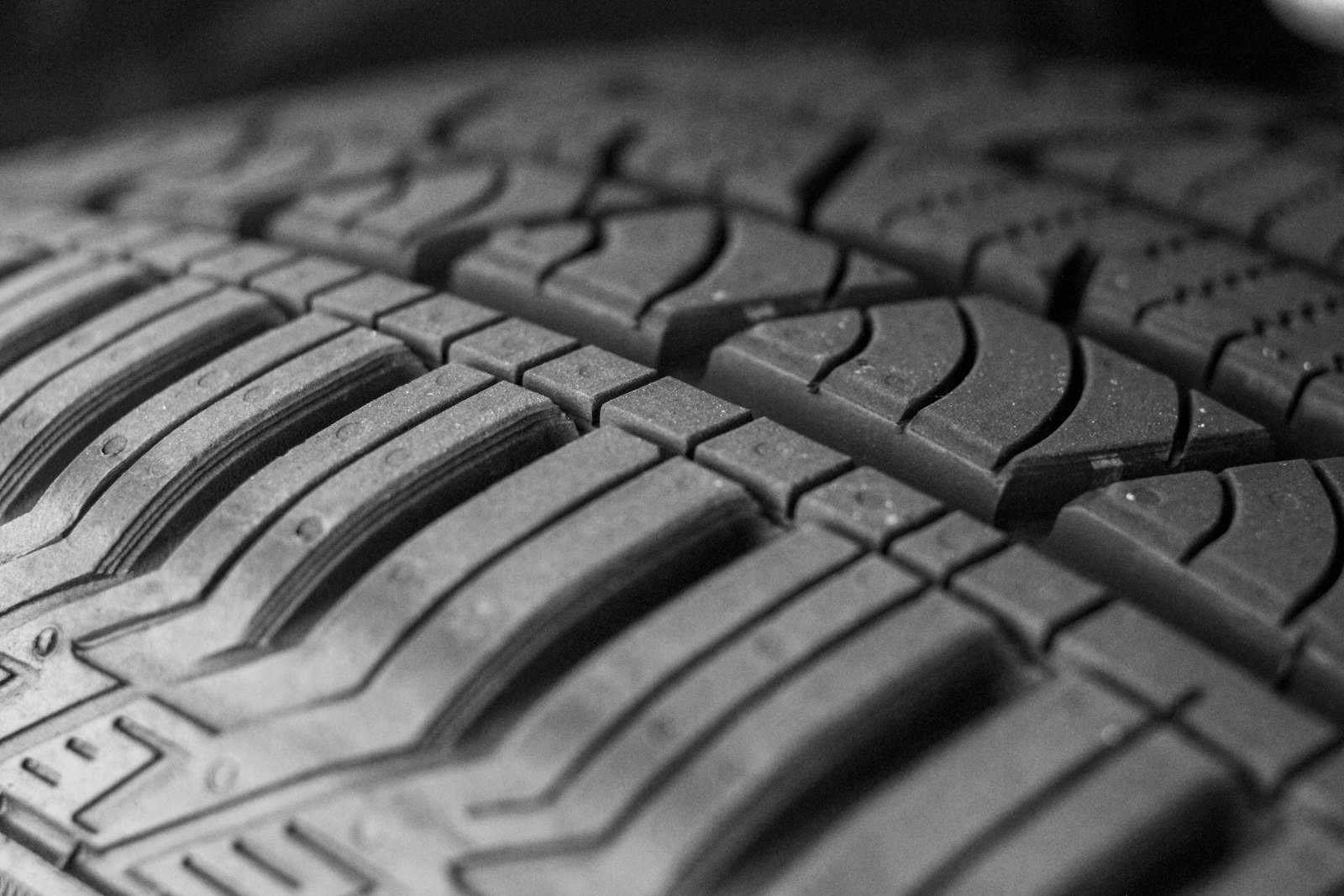
The tread is the patterned band of rubber that touches the road. It is cut with deep main grooves, usually running round the tyre, and with fine slits in the blocks called sipes, which help grip but are much shallower.
The DVSA’s MOT inspection manual makes the distinction explicit: grooves that contain tread wear indicators, or that were cut as deep as them when the tyre was new, are the primary grooves. The shallower grooves and sipes are ignored when tread depth is assessed. So measure in the main grooves, never in a sipe, or you will think a healthy tyre is finished.
The breadth of tread is the part of the tyre that touches the road in normal use, measured straight across. Take the middle three-quarters of that width and check that the main grooves are at least 1.6mm deep everywhere inside it.
How to check your tread depth at home
You can do this yourself in ten minutes, with the car parked on level ground and the steering turned to full lock so the front tyres are easy to see.
Tread wear indicators
Look in the bottom of the main grooves: every few hand-widths around the tyre there is a small raised bar of rubber across the groove. These are the tread wear indicators, moulded at the legal minimum. When the surface of the tread is level with them, the tyre is at the limit and must be replaced. On the sidewall, a small triangle or the letters TWI often mark where they are.
They need no tool and no coin. Their weakness is that they only tell you “at the limit or not”, and by the time a tyre is flush with them it has already lost a good part of its wet grip.
A tread depth gauge
A tread depth gauge is a small probe with a scale in millimetres, sold in car accessory shops and supermarkets for a few pounds. Push the body flat on the tread blocks, let the probe drop to the bottom of a main groove and read the figure.
Measure each tyre in three places across its width (inside, centre, outside) and at three or four points round the circumference, rolling the car a little between readings. Write the figures down. A tyre that reads 4mm on the outside and 2mm on the inside is telling you something about the car, not just about the tyre.
The 20p test, honestly
The test most retailers describe is simple: slide a 20p coin into a main groove. If the outer band of the coin is hidden, the tread is comfortably above the minimum. If you can see the band, measure properly or have the tyre checked.
It is a useful screening test, nothing more. A coin cannot show the difference between 1.6mm and 2mm, coins in circulation are worn to different degrees, and it is easy to drop it into a shallow groove by mistake. Use it to decide whether to look closer, then trust the wear bars or a gauge.
Uneven wear: what the pattern tells you
A tyre does not always wear evenly, and the shape of the wear points to the cause.
| What you see | Likely cause |
|---|---|
| Both outer edges worn | Tyre run under-inflated |
| Centre worn more than edges | Tyre run over-inflated |
| One edge worn, inside or outside | Wheel alignment out, often after a kerb strike or worn suspension parts |
| Patches or scalloped dips round the tyre | Worn shock absorbers, or a wheel out of balance |
| One flat spot | Hard braking with a locked wheel, or a car left standing a long time |
The inside edge deserves a special look, because you cannot see it from the kerb. At the workshop counter, it was the classic surprise: a front tyre that looked fine from outside and was down to the cords on the inner shoulder. Run a hand round the inside, or look at it with the wheel turned to full lock and a torch.
Pressure problems are the easy fix: our guide on what your tyre pressure should be shows where to find your car’s figure. Edge wear on one side needs a wheel alignment check, the adjustment of the angles at which the wheels sit, which is a job for a garage with the right equipment.
Penalties and the MOT
As of November 2026, GOV.UK states that driving a vehicle in a dangerous condition can lead to a fine of up to £2,500, a driving ban and 3 penalty points. GOV.UK’s own road safety campaigns describe this as applying per illegal tyre, so a car with several worn tyres can collect points on each one. Twelve points within three years can lead to a ban.
At the MOT, tread below the legal limit is classed as a dangerous defect in the DVSA inspection manual. The car fails, and a dangerous defect means it should not be driven away until it is repaired. The same check also fails tyres with a cut deep enough to reach the cords, any exposed cord, or a bulge or lump caused by the tyre’s structure breaking down.
The MOT only looks at the car once a year. Tyres can go from legal to illegal in a few thousand miles, especially with an alignment problem, so the annual test is no substitute for your own checks.
When to replace a tyre in practice
The legal limit is a floor, not a target. As grooves get shallower they clear less water from under the tyre, so the distance needed to stop on a wet road grows and the risk of aquaplaning, the tyre riding up on a film of water and losing contact with the road, rises. Tyre makers and road safety bodies commonly advise changing at about 3mm for that reason.
A practical rule: start planning the replacement when your gauge reads around 3mm, and do not let a car you drive in the wet through winter go into it with tyres close to 2mm. Replace tyres in pairs on the same axle so both sides grip alike, and if only two new ones are fitted, many tyre makers recommend putting them on the rear axle to keep the back of the car stable in the wet. Check what the tyre maker or your handbook says for your car.
Tread is not the only reason to change a tyre. Cracks in the sidewall, a bulge, a cut showing cords or a repair made too close to the shoulder all mean replacement, whatever the depth. More tyre and braking topics are in our Safety section.
What you can do yourself, and what needs a garage
Checking the depth, looking for cuts and bulges and reading the wear pattern is a job for anyone with a gauge and a torch. Swapping a wheel for the spare is fine for a confident driver on safe, level ground.
Fitting a new tyre to a rim, balancing it and setting the alignment need a tyre machine, a balancer and an alignment rig, and the wheel nuts must go back on at the torque in the handbook. Hand those to a garage, and ask to see the old tyres and their depth before they go in the skip.
